
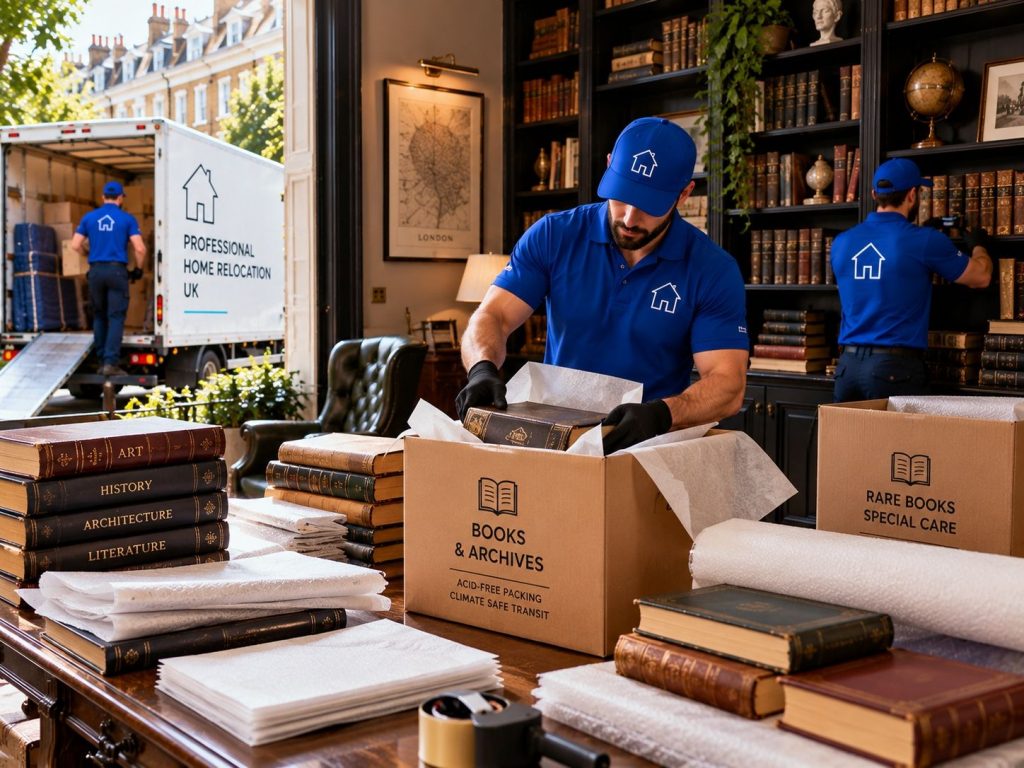
Relocating Your Home Library and Rare Book Collections: Moisture Control and Archival Packing
For avid bibliophiles, academics, and private collectors across the UK, a personal library is far more than a decorative interior feature. It represents decades of curated reading, historic first editions, signed literary copies, antique leather bindings, and irreplaceable research folios.
However, moving a substantial volume of books is one of the most deceptively complex logistics projects in residential moving. Books are exceptionally dense and heavy; a standard three-foot bookshelf holds upwards of 35 kilograms of printed material. Packed improperly into oversized boxes, cartons buckle under shear weight, seams blow out on stairwells, and book blocks warp permanently out of square.
Furthermore, antique paper, calfskin leather, and vellum bindings react immediately to external conditions. Transporting private collections through damp UK weather exposes organic fibres to relative humidity spikes, cockling paper leaves, and dormant fungal spores.
Hiring certified packers and movers alongside a dedicated provider of professional home relocation UK services ensures your library is catalogued, archivally wrapped, and transported safely within climate-stable transit conditions.
The Hidden Risks of Moving Books and Antique Folios
Paper is a hygroscopic, porous material that constantly absorbs and desorbs ambient atmospheric moisture. When shifting books from temperature-regulated private rooms into commercial vehicles, collectors face several distinct physical and environmental hazards:
- Atmospheric Moisture and Condensation Traps:
- UK mornings—especially during autumn and winter moves—frequently feature relative humidity levels exceeding 85%.
- Sealing cold books into impermeable plastic boxes or tight polythene bubble wrap creates condensation sweat pockets, leading to cockling pages and rapid mould outbreaks within 48 hours.
- Structural Joint Strain and “Spine Break”:
- Packing volumes with their fore-edges facing downward forces the entire gravitational weight of the internal text block away from the binding.
- Over a bumpy transit journey across London cobblestones or rural motorways, heavy paper blocks tear free from endpapers, splitting delicate cloth and leather hinges.
- Corrugated Box Collapse and Overloading:
- Books have a very high mass-to-volume ratio. Filling large utility moving cartons with dense hardbacks results in 40-to-50 kg boxes that bow in the middle.
- When stacked inside a vehicle, the lower cartons crumple under pressure, crushing the bottom volumes and bending fragile book corners.
- Chemical Contamination from Standard Packaging:
- Low-grade commercial newsprint contains high lignin and acid concentrations that migrate directly into historic paper leaves, causing acid staining and permanent discoloration on antique endpapers.
Archival Packing Protocols: Safeguarding Paper, Leather, and Vellum
Preserving rare bindings requires conservation-grade packing protocols designed to cushion structures without introducing chemical degradation:
- Unbuffered, Acid-Free Tissue Wrapping:
- Individual antiquarian volumes, 19th-century cloth editions, and leather-bound sets must be wrapped individually in acid-free, lignin-free tissue paper.
- This creates a breathable, non-abrasive protective layer that prevents gilt lettering from rubbing against adjacent covers.
- Archival Microchamber Paper for Acidic Paper Stocks:
- For fragile 20th-century paperbacks and vulnerable modern first editions, interleaving or wrapping with zeolite-infused archival paper captures air pollutants and neutralises residual off-gassing.
- Special Handling for Calfskin and Vellum:
- Vellum bindings warp severely with sudden shifts in atmospheric moisture.
- Wrapping vellum in pure cotton cloth or conservation-grade glassine prevents humidity shocks and keeps binding covers flat.
- Silica Gel Desiccant Integration:
- Certified moving crews position measured pharmaceutical-grade silica gel canisters inside archival book boxes to regulate internal relative humidity between 45% and 55% throughout transit.
Mechanical Packing Standards: Spine-Down vs Flat Stacking
How books sit inside a carton dictates whether they arrive in showroom condition or with broken hinges:
- The Spine-Down Alignment Rule:
- Volumes positioned vertically must always be packed spine-down, with the fore-edge pointing upward toward the carton lid.
- This ensures the internal text block rests firmly against the solid backbone of the spine, eliminating gravitational tear on internal sewing cords.
- Horizontal Flat Stacking for Large Folios:
- Oversized architectural folios, atlases, and heavy art volumes should never be packed vertically.
- Lay these volumes flat, stacking the largest and heaviest folios at the base, with maximum stack heights limited to three or four volumes to prevent spine splaying.
- Uniform Height Grouping:
- Group books of identical heights alongside one another so covers support each other evenly across their entire surface planes.
- Packing a small octavo volume next to a tall quarto creates uneven lateral gaps that bend boards under transport vibrations.
- Eliminating Void Space with Acid-Free Corrugated Spacers:
- Any remaining internal gaps inside cartons must be filled with folded unbleached packing paper or corrugated cardboard pads, ensuring books cannot slide, tilt, or rub during transport.
The Golden Rule of Book Relocation: Small Double-Walled Cartons
Managing heavy library volumes requires strict control over carton dimensions and structural durability:
- Heavy-Duty Double-Walled Book Boxes:
- Professional movers use reinforced, double-walled corrugated boxes with internal dimensions no larger than 40 cm x 30 cm x 30 cm (approx. 1.5 cubic feet).
- Smaller box footprints prevent bowing and ensure the structural cardboard corners bear all vertical loads when stacked.
- The 18 Kilogram Weight Ceiling:
- Keep individual book box weights capped at 15 to 18 kilograms.
- This allows moving crews to carry cartons smoothly without sudden, jarring movements that could throw a carrier off balance on steep stairs.
- The “H-Tape” Base Sealing Method:
- Seal box bases using cross-directional reinforced vinyl or moisture-resistant cross-weave filament tape, sealing down the center joint and both edge seams.
- Never use interlocking “tuck-in” box flap techniques, which fail suddenly under heavy book blocks.
Climate-Stable Transport and Shelving Protocols
The journey inside the vehicle and the arrival at your new residence require methodical care:
- Weather-Sealed, Dry Moving Vehicles:
- Professional removal fleets utilize clean, watertight Luton vans fitted with internal plywood battens and load-securing rails.
- Cartons are strapped directly against structural bulkheads to ensure no shifting occurs over speed humps or sharp turns.
- Avoiding Ground-Level Concrete Placement:
- Never unload book cartons directly onto bare basement concrete or damp ground-floor flagstones.
- Cartons should be staged on raised wooden pallets or breathable moving blankets to prevent cold floor moisture from wicking into carton bases.
- Controlled Acclimatisation Before Unpacking:
- Allow packed book cartons to acclimatise to the room temperature of your new library for 24 hours before opening them.
- Opening cold cartons in a freshly heated room can pull ambient moisture directly onto chilled paper leaves.
- Systematic Shelf Re-Assembly:
- Numbering box sequences to match original bookshelf positions ensures your library order is preserved effortlessly without weeks of sorting.
Library Relocation Readiness Checklist
- [ ] Audit and catalogue your collection, noting first editions, signed copies, and high-value antique bindings.
- [ ] Source specialist, double-walled book cartons measuring no larger than 1.5 cubic feet.
- [ ] Wrap rare leather, vellum, and gilded volumes individually in acid-free archival tissue paper.
- [ ] Pack upright volumes spine-down and lay oversized folios flat in small stacks.
- [ ] Cap box weights strictly at 15 to 18 kg and seal bases with reinforced H-pattern tape.
- [ ] Integrate silica gel humidity regulators within cartons containing sensitive antique paper.
- [ ] Verify that your removal provider carries dedicated Goods in Transit insurance covering antiquarian books.
How Removal Squad Protects Your Private Library
At Removal Squad, we recognize that personal book collections represent immense cultural, sentimental, and financial value. Our specialized packing crews are trained in conservation-standard handling, structural weight management, and clean transit methods designed to safeguard delicate collections.
Our specialist library moving solutions include:
- Specialist Packers and Movers: Expert packing teams supplied with acid-free tissue, rigid double-walled book cartons, and custom protective padding.
- Professional Home Relocation UK: Fully managed residential relocations structured around heavy academic libraries, heritage properties, and private collections.
- Dedicated London Moving Vans: Clean, modern, fully sealed, ULEZ-compliant Luton vans equipped with internal tie-rails and hydraulic tail lifts for smooth loading.
- Agile Man and Van Assistance: Flexible moving options perfect for partial library collections, academic office moves, and single-bookcase transfers.
- Secure Climate-Monitored Storage: Clean, dry, humidity-controlled container storage facilities available on flexible weekly terms for collection staging.
Preserve Your Collection with Specialist Care
Relocating your library should not mean risking damaged bindings, torn hinges, or humidity-related paper damage. By using archival materials, adhering to spine-down packing standards, and partnering with experienced removal specialists, you ensure your cherished books arrive ready to take pride of place on your new shelves.
Planning a home library or antiquarian book move in London or across the UK? Contact Removal Squad today to book your bespoke inventory survey and receive a transparent, tailored moving quotation.
Credit: The British Library Preservation Guidelines & Antiquarian Booksellers’ Association (ABA) Standards