
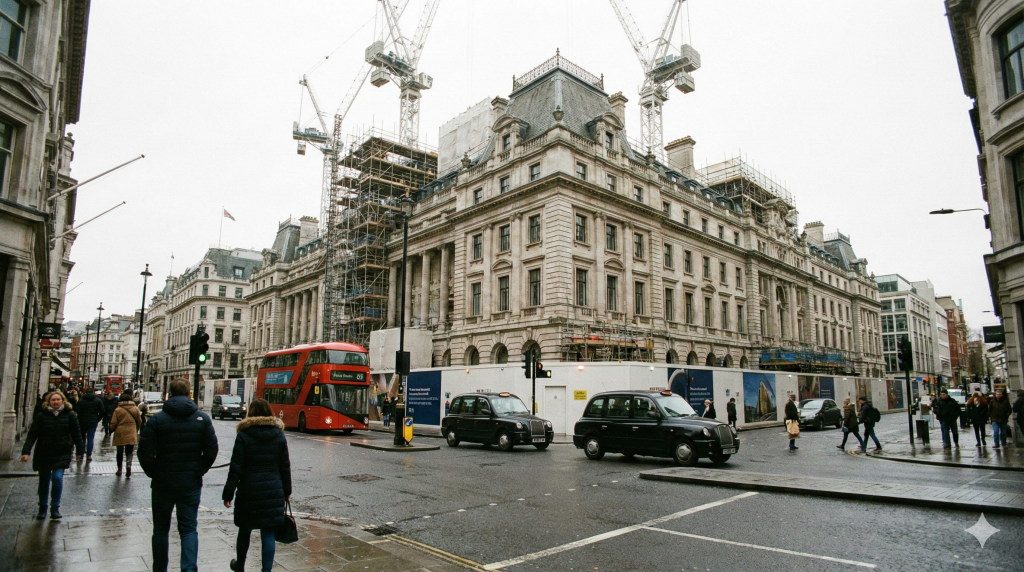
London’s commercial landscape is constantly evolving, but every so often a development arrives that signals a genuine shift in how the city works. The recent unveiling of the One Hanover Street scheme by The Crown Estate is one such moment. More than a new building, it represents a statement of confidence in the future of the West End office market and in London’s continuing role as a global business hub.
With 124,000 square feet of space fully pre-let to global investment firm Ares Management, the project stands out not only for its scale but for what it reveals about changing business priorities: quality over quantity, flexibility over rigidity, and location over compromise.
For companies watching the West End closely, this development offers a glimpse into how workspaces, working patterns, and relocation strategies are likely to develop over the coming decade.
A West End Market in Transition
The West End has long been one of London’s most sought-after office districts, balancing prestige with proximity to transport, culture, and clients. Yet in recent years, questions have been raised about the future of traditional offices in a post-pandemic world.
The One Hanover Street project answers many of those questions.
Rather than shrinking, demand for high-quality, centrally located space appears to be intensifying. The fact that the entire building was secured by a single occupier before completion highlights a key trend: large organisations are consolidating into fewer, better buildings that offer flexibility, sustainability, and long-term value.
This mirrors patterns seen across central London, where prime locations continue to outperform secondary stock.
Why One Hanover Street Matters
The location alone makes this redevelopment notable. Situated just off Regent Street, One Hanover Street sits at the heart of the West End, close to major transport routes and surrounded by retail, hospitality, and cultural landmarks.
But the importance of the project goes beyond geography.
A signal of confidence
Fully pre-letting a building of this size sends a clear message: major firms are willing to commit long-term to central London. Despite hybrid working models, the office remains central to business strategy, culture, and collaboration.
A focus on quality
Modern office occupiers are no longer simply looking for desks and meeting rooms. They want:
- Energy-efficient buildings
- Flexible floorplates
- High-quality amenities
- Space that supports wellbeing and productivity
The Crown Estate has positioned this scheme as a future-ready workplace, aligning with wider sustainability and design standards now expected across the West End.
The Ripple Effect Across the Business Community
Large redevelopments rarely affect only one company. They tend to create a ripple effect across the surrounding market.
When a flagship occupier secures a prime building:
- Competing firms reassess their own premises
- Smaller businesses seek space nearby to benefit from proximity
- Landlords upgrade older stock to remain competitive
- Support services see increased demand
In practical terms, this means more companies are reviewing whether their current offices still match their needs. Expansion, consolidation, and relocation become part of strategic planning rather than reactive decisions.
Relocation as a Strategic Business Decision
Moving offices is no longer just about finding more space. Increasingly, it is tied to:
- Talent attraction and retention
- Brand positioning
- Environmental responsibility
- Long-term cost efficiency
A move into a modern West End building often reflects a company’s ambition and maturity. It signals stability to clients, confidence to investors, and commitment to staff.
However, such moves are rarely simple.
Timelines must align with lease breaks, fit-out schedules, and business operations. Assets must be protected. Downtime must be minimised. And compliance, access restrictions, and local regulations must be carefully managed.
This is why relocation planning is now considered part of corporate risk management, not just facilities management.
The Crown Estate Redevelopment as a Catalyst for Change
How The Crown Estate redevelopment Is Reshaping West End Relocation Patterns
The Crown Estate redevelopment is already influencing how businesses think about location, timing, and scale.
As premium schemes set new benchmarks, companies occupying older or less efficient buildings face a choice: invest in upgrades or move to modern space.
This process drives:
- Increased movement within central London
- Phased relocations rather than single-day moves
- Greater use of interim storage and flexible working arrangements
- Higher demand for specialist commercial relocation expertise
In effect, each major development accelerates the natural churn of the office market, refreshing not just buildings but business strategies.
London’s Infrastructure Advantage
One reason the West End continues to outperform is its infrastructure.
With multiple Underground lines, Crossrail connectivity nearby, and walkable access to major districts, central London remains uniquely efficient for client-facing organisations.
This accessibility is a key reason why global firms continue to favour locations like Hanover Street, even when remote working is an option.
For international firms entering or expanding in the UK, the West End still offers a combination of prestige, practicality, and global recognition that few districts can match.
Preparing for the Next Generation of Office Moves
As developments like One Hanover Street redefine expectations, companies planning moves need to think differently.
Key considerations now include:
- Staged relocation to avoid operational disruption
- Digital mapping of assets before moving
- Sustainability targets for disposal and recycling
- Security protocols for sensitive material
- Business continuity planning during transition
The complexity of modern relocations reflects the complexity of modern business.
How Removal Squad Supports London’s Commercial Transitions
While this article focuses on the wider market, it is impossible to ignore the practical realities that sit behind every successful relocation.
Removal Squad works alongside London businesses navigating these transitions, providing specialist support when location, timing, and operational continuity matter most.
Below is an overview of core services, offered as part of a fully managed commercial relocation approach:
- Office removals – Planned business relocations designed to minimise downtime and protect critical assets.
- Removal van London – Appropriately sized vehicles for navigating central London access, congestion, and restricted zones.
- Packers and movers – Professional packing for IT equipment, documents, and sensitive workplace assets.
- Courier services – Secure same-day transport for urgent files, hardware, and priority business items.
- Man and van removals – Flexible solutions for small office moves, internal relocations, and phased transitions.
- Storage – Short- and long-term secure facilities to support staggered moves and refurbishment timelines.
- Clearance – Responsible removal, recycling, and disposal of redundant furniture and equipment.
Each service is designed to integrate into wider relocation strategies rather than operate as a standalone task.
Looking Ahead: A West End That Continues to Evolve
The One Hanover Street project is unlikely to be the last major announcement from The Crown Estate or the West End more broadly.
With sustainability targets tightening, occupier expectations rising, and competition for prime space intensifying, the next decade will see:
- More redevelopment of existing buildings
- Greater emphasis on ESG performance
- Higher design standards across new schemes
- Continued movement of businesses within central London
For companies, this means relocation will remain a regular feature of long-term planning.
A Turning Point for the West End Office Market
The Crown Estate redevelopment at One Hanover Street is more than a single office project. It is a marker of confidence in central London, a signal of changing workplace priorities, and a catalyst for renewed movement across the West End.
As businesses respond to these shifts, thoughtful planning, professional execution, and strategic support will define who benefits most from London’s next phase of growth.
For those preparing to take their next step in the capital, the future of the West End is not just being built; it is already being occupied.
Credit: Insider Media