
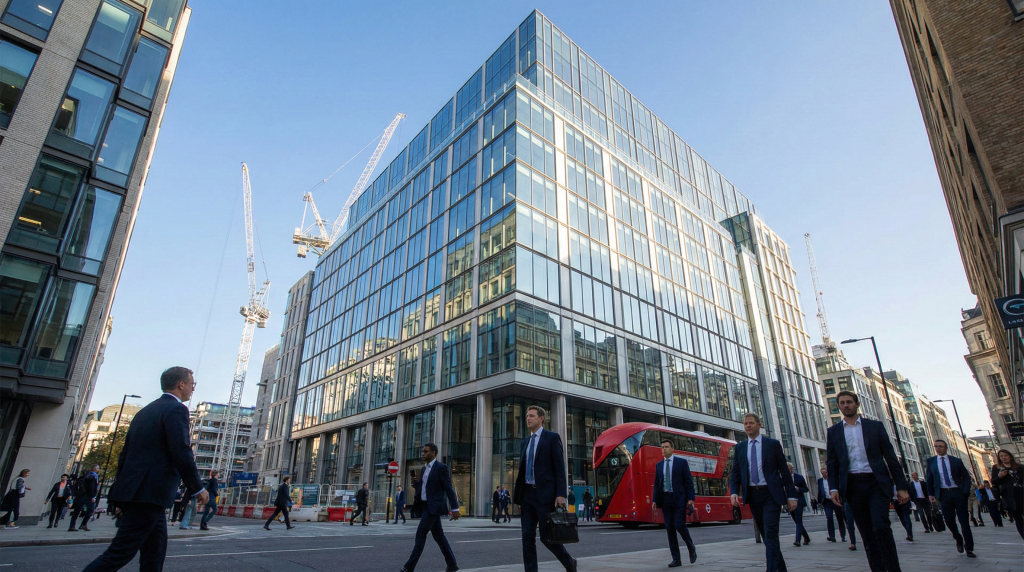
The City of London’s commercial property sector is showing clear signs of renewed momentum. A new City of London office development, One Exchange Square, has recently drawn attention after securing a significant proportion of its space through pre-let agreements well ahead of completion. This level of early commitment points to a wider return of business confidence in London’s office market.
According to industry reports, more than 238,000 sq ft of office space at the development has already been let, reflecting sustained demand for high-quality, well-located workplaces in the heart of the capital.
Confidence Returns to the City Office Market
The strong performance of this development is not an isolated case. Across the City, businesses are reassessing their workplace strategies, prioritising modern buildings that offer flexibility, sustainability, and proximity to clients and transport hubs.
A new City of London office development achieving high occupancy levels before completion suggests that companies are planning ahead rather than delaying decisions. This confidence is being driven by:
- A renewed focus on collaboration and in-person work
- Demand for energy-efficient, future-proofed office space
- The City’s continued role as a global financial and professional services hub
From Leasing Activity to Physical Moves
While leasing announcements often focus on square footage and tenants, they also signal something more practical: movement. Once agreements are signed, businesses begin the complex process of transitioning from old premises into new environments.
New developments typically require careful planning around fit-outs, timelines, and logistical coordination. For many occupiers, this involves relocating staff, equipment, furniture, and records within tight timeframes; particularly in dense areas such as the Square Mile.
Why New Developments Change How Businesses Relocate
Modern office buildings are designed differently from older stock. Floorplates are larger, layouts are more flexible, and sustainability features often require precise installation and setup. As a result, relocation projects linked to new developments tend to be more structured and phased.
Companies may also need interim solutions, such as temporary space or off-site handling of surplus assets, while move-in dates are finalised. This makes planning and execution just as critical as the leasing decision itself.
Removal Squad Services That Support Business Moves
When organisations prepare to transition into newly developed office space, specialist support helps ensure continuity and efficiency:
- Office removals – Planned relocations designed to minimise business disruption.
- Removal van London – Appropriately sized vehicles suited to City access and scheduling.
- Man and van removals – Flexible support for smaller office moves or phased transitions.
- Packers and movers – Professional handling of furniture, equipment, and documents.
- Storage – Secure short- or long-term solutions during fit-out or staggered moves.
Clearance – Responsible removal of redundant furniture and materials from previous premises.
Looking Ahead
As new City of London office developments continue to attract early commitments, the pattern is clear: businesses are investing in their future presence in the capital. Beyond the headlines, each leasing deal represents a practical shift; people moving, spaces changing, and operations evolving.
For organisations preparing to make that transition, understanding the broader market context is just as important as planning the move itself.
From office transitions to logistics planning, Removal Squad helps London businesses navigate complex moves with clarity and efficiency.
Credit: BE News