
Moving Between London Boroughs: Managing Council Parking Bay Suspensions and Yellow Lines
Relocating between London boroughs involves far more than planning a transit route across the Thames or around the North and South Circulars. Across the capital’s 32 distinct borough councils and the City of London, parking regulations operate under entirely different administrative rules, application portals, notice deadlines, and fee structures.
A removal process that works effortlessly on a quiet residential road in Wandsworth can lead to immediate complications in the Controlled Parking Zones (CPZs) of Camden, Westminster, Lambeth, or Islington. Between strict kerbside enforcement, red route restrictions managed by Transport for London (TfL), and narrow mews, failing to coordinate parking access is the single leading cause of move-day delays and penalty charge notices (PCNs).
Booking an experienced London removal van team and understanding how to navigate parking suspensions and loading dispensations guarantees that your man and van removals London service parks legally, safely, and steps from your front door.
Parking Suspensions vs. Dispensations: Understanding the Legal Difference
When planning kerbside parking for a removal vehicle in Greater London, councils provide two separate legal permissions that serve different purposes:
- Parking Bay Suspensions:
- What It Does: Physically reserves dedicated marked bays (such as resident permit bays, pay-and-display spaces, or shared-use bays) exclusively for your removal vehicle.
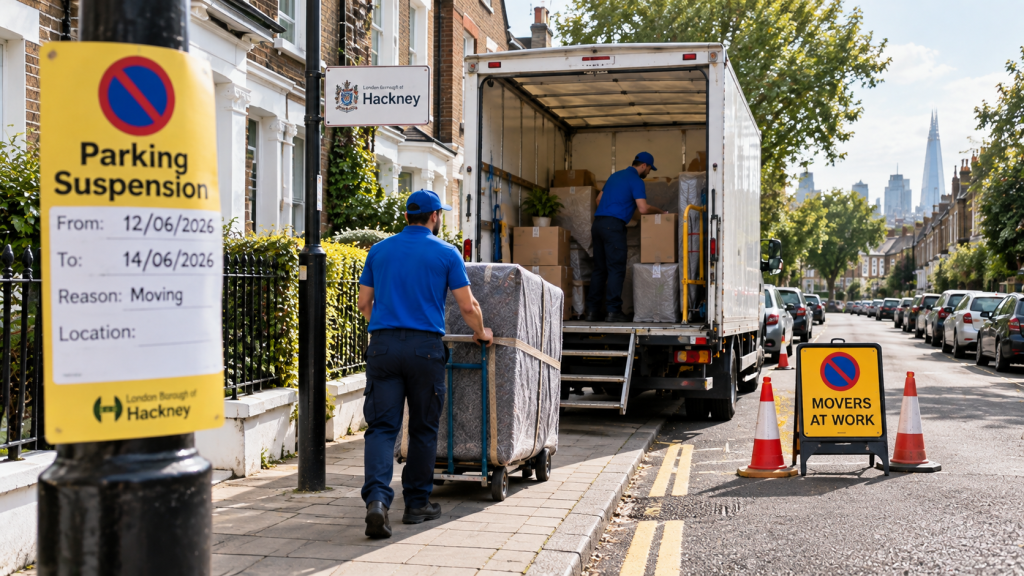
- Visual Identification: Council highway contractors install high-visibility yellow warning signs or yellow hood covers on parking meters 3 to 7 days in advance.
- Best Used For: Full home removals, multi-bedroom flat transitions, and multi-hour loading operations requiring guaranteed, uninterrupted access.
- Parking Dispensations (Yellow-Line Waivers):
- What It Does: Grants written permission for a specific commercial vehicle registration to park on single yellow lines (or during controlled hours) where waiting is otherwise prohibited.
- Crucial Limitation: A dispensation does not reserve the space or guarantee that kerbside space will be clear of other vehicles.
- Best Used For: Agile moves, compact flat transitions, or properties located where no designated marked bays exist outside the entrance.
Borough-by-Borough Parking Rules: Lead Times and Fees
Because every London local authority sets its own policies, application windows vary dramatically. Missing a deadline can prevent a council from processing your reservation in time for completion day:
- London Borough of Camden:
- Notice Period Required: Up to 17 working days for residential parking bay suspensions—among the longest notice windows in Greater London.
- Fee Structure: Standard administration charge of £66.66 per application, with fee exemptions or discounts often applied to the first day of a domestic move for up to three bays.
- Operational Tip: Camden’s historic conservation areas often feature narrow streets; booking at least three weeks ahead is critical.
- City of Westminster:
- Notice Period Required: Minimum of 10 working days. Late applications submitted within 10 calendar days incur a mandatory £20 short-notice fee.
- Fee Structure: Tiered charging bands depending on location zones, starting from £51 to £55 for day one per five-metre space, increasing for subsequent days.
- Operational Tip: Parking bays in Soho, Mayfair, and Marylebone are heavily monitored; vehicles without active digital permits receive swift PCNs.
- London Borough of Islington:
- Notice Period Required: 14 calendar days for resident bays (10 working days for pay-by-phone locations).
- Fee Structure: Islington has historically offered free domestic parking bay suspensions for resident moves, making it one of the most resident-friendly boroughs in the capital.
- Operational Tip: Yellow-line waivers require separate applications with a minimum 5-day notice period.
- London Borough of Lambeth:
- Notice Period Required: At least 10 working days prior to the move date via the council’s online suspension portal.
- Fee Structure: Fixed administrative and daily space fees, with yellow warning signage placed approximately three days before work starts.
- Operational Tip: Lambeth requires vehicle registration numbers to be logged directly into the suspension portal before parking; unlisted vehicles risk immediate PCNs.
The Rules of Yellow Lines and Loading Exemptions
Many people assume removal vehicles can park on yellow lines without permission as long as loading is underway. While statutory loading exemptions exist, they come with strict limitations:
- The Active Loading Rule:
- Commercial vehicles are generally permitted to stop on single or double yellow lines for up to 20 minutes to load or unload bulky goods, provided there are no active loading bans.
- Loading must be continuous and observable; if civil enforcement officers observe a vehicle with no activity for more than 2 to 5 minutes, a PCN will be issued.
- Kerb Blips (Loading Restrictions):
- Single or double yellow stripes painted perpendicular across the kerb signify strict loading bans.
- One kerb blip indicates loading is banned during specific morning or evening rush-hour times; two kerb blips indicate loading is prohibited 24 hours a day, 7 days a week.
- Transport for London (TfL) Red Routes:
- Red routes make up 5% of London’s roads but carry over 30% of its traffic.
- Stopping, loading, or parking on double red lines is strictly forbidden at all times and enforced via automated CCTV cameras.
- Loading bays on red routes feature red or white broken lines that mandate strict 20-minute maximum loading windows during off-peak hours.
How Vehicle Sizing Affects Kerbside Parking Requirements
Selecting the right vehicle size directly determines how many parking bays you must suspend, impacting both council application costs and street congestion:
- 3.5-Tonne Luton Moving Vans:
- Length Required: Approximately 6 to 7 metres, requiring two standard 5-metre parking bays for safe ramp deployment and loading.
- Street Maneuverability: Highly agile, fitting comfortably into residential crescents and narrow Victorian streets without blocking two-way traffic.
- 7.5-Tonne Removal Lorries:
- Length Required: Requires three to four consecutive parking bays (12 to 15 metres) to allow rear tail lift operation.
- Access Vulnerabilities: Suspending three bays increases council costs and raises the likelihood of unauthorised cars ignoring warning signs.
- Multi-Drop Van Strategies:
- For moves between tight urban boroughs, deploying two Luton vans often provides greater flexibility than a single heavy lorry, making parking easier to secure outside both properties.
What to Do If an Unauthorised Car Parks in Your Suspended Bay
Even with official yellow council signs in place, unauthorised private vehicles occasionally park in suspended bays. Professional moving crews handle this scenario through clear protocols:
- Contact Council Parking Enforcement Immediately:
- Report the vehicle’s registration number directly to the local council’s parking dispatch team.
- In boroughs such as Westminster, Camden, and Kensington & Chelsea, parking wardens can be dispatched to issue a PCN and coordinate relocation via council tow trucks.
- Deploy Hazard Signage and Safety Cones:
- Removal crews position high-visibility cones and deploy hazard warning lights to indicate legitimate moving activity while enforcement handles the obstruction.
- Utilise Nearby Commercial Loading Bays:
- If a vehicle cannot be moved immediately, experienced drivers position the van in adjacent legal bays or nearby single yellow zones while initiating room-by-room packing.
London Parking Management Checklist
- Check the required notice period for both collection and delivery boroughs at least 3 weeks before move day.
- Measure the kerbside space outside both properties to determine whether two or three bays are needed.
- Apply for parking bay suspensions through the respective council portals and retain digital reference numbers.
- Confirm that your removal partner’s vehicle registration numbers are updated in the council portal prior to arrival.
- Verify whether the destination address sits on a TfL Red Route or within a restricted loading zone.
- Arrange flexible storage units if parking delays or lease overlaps require a phased move.
How Removal Squad Navigates London Parking with Ease
At Removal Squad, our drivers and move coordinators manage the complexities of London parking daily. We understand the specific regulations across every London borough, ensuring your moving vehicles are compliant, well-positioned, and fully protected from parking fines.
Our comprehensive moving solutions include:
- Dedicated London Removal Vans: Clean, modern, ULEZ-compliant Luton vans equipped with ramps, tail lifts, and protective equipment.
- Agile Man and Van Assistance: Flexible, budget-friendly transport ideal for navigating tight residential postcodes and short loading windows.
- Local Home Removals: Comprehensive residential moving solutions tailored to high-density apartment blocks and urban housing estates.
- Expert Packers and Movers: Professional packing teams who stage and box items efficiently to minimise loading time on the kerb.
- Secure Interim Storage Units: Safe, dry container storage facilities available on flexible weekly terms to support phased property moves.
Make Your Inter-Borough Move Completely Hassle-Free
Navigating parking rules across different London councils does not have to disrupt your relocation. By checking application lead times early, reserving the necessary bay space, and partnering with an experienced removal team that knows the capital’s streets, you ensure your moving day proceeds without delay or unexpected penalty notices.
Planning a move between London boroughs? Contact Removal Squad today to book your free survey and let our logistics specialists coordinate your move.
Credit: Transport for London (TfL) & London Councils Parking and Traffic Guidelines